
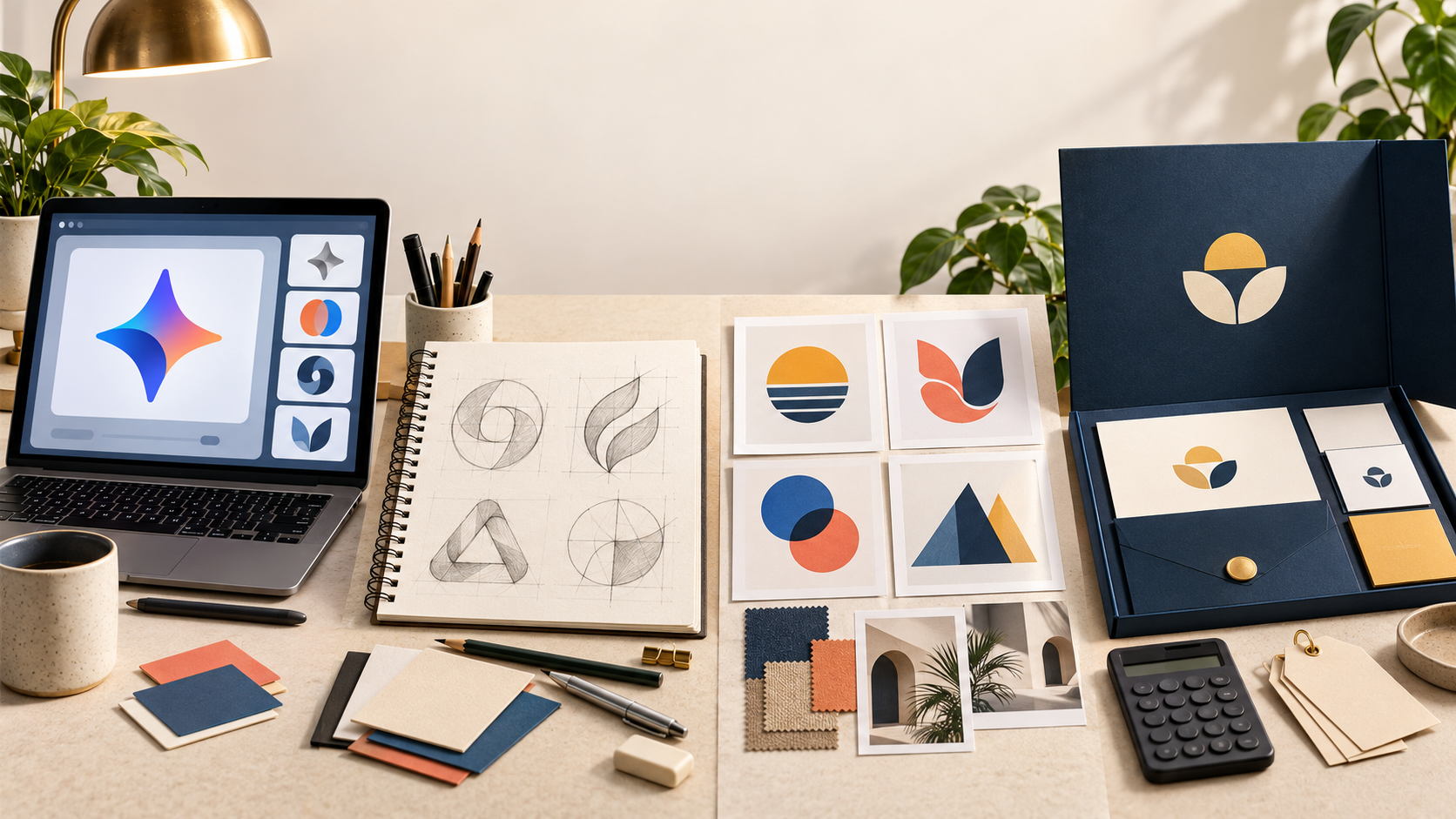
Updated October 2026. “How much should a logo cost?” sounds like a simple question, but the useful answer is not one number. A logo can be a quick starting point for a side project, a carefully refined asset for a growing local business, or one part of a full identity system. Those are different jobs, so they come with different levels of time, collaboration, and cost.
The best budget is the one that matches the decision you are making. If you need a credible first look for a new idea, speed and exploration may matter most. If the logo will be applied to storefronts, product packaging, a vehicle fleet, or an investor-facing brand, a more deliberate process may be worth the investment. This guide compares four common routes: AI tools, freelance designers, logo contests, and agencies.
The short answer
An AI logo maker is usually the fastest and lowest-commitment way to explore directions. A freelancer is a good fit when you want direct one-to-one collaboration and a defined brief. A design contest can be useful when you want to compare multiple custom approaches before choosing a direction. An agency is best when the work includes research, positioning, and a broader identity system beyond the logo itself.
Do not compare only the first price you see. Compare the number of concepts, quality of feedback, revisions, usable file types, ownership terms, and brand assets included. A cheap logo that cannot be used on a sign, social profile, or print piece can create more work later. A large identity package can also be unnecessary if your business still needs to prove its offer.
What you are actually paying for
The visible mark is only one part of logo design. Depending on the route, your investment may pay for discovery, creative direction, concept exploration, typography, color decisions, revisions, file preparation, and usage guidance. The scope can grow further when you need business cards, social templates, packaging, signage, or a brand guide.
That is why a price comparison needs a shared checklist. Ask every provider: How many concepts will I see? Who is making the work? How many revision rounds are included? Which final files will I receive? Is there a one-color version, a horizontal version, and a small icon option? What happens when I need an adjustment next year? The U.S. Bureau of Labor Statistics overview of graphic designers is also a useful reminder that design is a professional field with a broad range of roles; a project quote reflects scope and expertise, not simply the time needed to draw a symbol.
Option 1: AI logo makers
AI tools are strong at getting a founder from blank page to options quickly. You enter a business name and a few details, explore different styles, and refine the concepts that feel promising. This can be a sensible path for a new side project, a temporary launch identity, a simple service business, or anyone who wants to learn their preferences before committing to a custom process.
The real value is exploration. A set of generated concepts can teach you that you prefer a wordmark to an icon, a calm palette to a bold one, or a simple layout that will survive at small sizes. It gives you useful language for a later brief. The trade-off is that you are responsible for the judgment: checking legibility, avoiding a generic industry look, and deciding whether the concept truly fits the promise of the business.
Use this route when you have a modest budget, a clear enough vision to make selections, and a need to move quickly. Slow down before adopting a result. Test the name in one color, at tiny size, on light and dark backgrounds, and alongside competitors. If the logo raises bigger questions about positioning or feels nearly right but not resolved, it may be time to bring in a designer.
Option 2: freelance designers
A freelance designer offers a direct relationship. You can choose someone whose portfolio and process fit your industry, then work through a brief, concept presentation, and feedback rounds. This is appealing when you already have a fairly focused direction and prefer to build a working relationship with one person.
The cost varies widely because the scope varies widely. A focused logo-only project is not the same as a designer helping to name a company, research competitors, create a custom type treatment, and prepare a brand toolkit. Before comparing quotes, write down what must be included. A clear brief protects both sides and makes it easier to tell whether you are comparing like with like.
Ask to see relevant work, not just attractive work. If you run a contractor business, look for examples that work on trucks and uniforms. If you sell a premium product, look for evidence that the designer can handle packaging and small-format marks. A good portfolio shows decisions applied to real surfaces, not only polished mockups.
Option 3: logo design contests
A contest gives you a different kind of value: several designers responding to the same brief. Instead of betting on one initial approach, you can compare multiple interpretations, choose finalists, and give feedback on the directions that feel closest. This can be helpful when you know the business but do not yet know which visual route will connect with customers.
At 48hourslogo, the currently listed logo packages are $129, $199, and $299. They vary in expected concept volume, finalist designers, contest duration, invitations, and brand assets. The full package page has the current inclusions, while the contest FAQ explains how the process and design selection work. Because packages can change, check those pages when you are ready to post rather than relying on an old price comparison.
The quality of the result depends heavily on the brief and the feedback. Be clear about your customers, industry, essential applications, visual preferences, and dislikes. Explain the problem you are solving instead of prescribing every visual detail. “We need to look dependable on a white service van and approachable to homeowners” gives a designer more useful direction than “use blue and a wrench.”
Option 4: agencies and full identity studios
An agency or identity studio is normally the most strategic route. The engagement may include workshops, audience research, competitive review, messaging, visual territories, a logo, colors, typography, illustration, photography direction, brand guidelines, and rollout support. It is a better fit when several stakeholders need alignment, when the company is repositioning, or when a high-visibility launch needs a unified system.
That depth is valuable, but it can be unnecessary for an early-stage business that has not yet settled its audience or offer. The mistake is not choosing a smaller option; it is pretending a small project needs an agency-sized process—or expecting a logo-only purchase to solve every brand problem. Match the investment to the decisions that need to be made now.
A simple way to choose your budget
Start with the risk of getting it wrong. If you are testing a weekend business, an AI-driven exploration or modest project can be enough. If the logo will be installed across a regional fleet, applied to expensive packaging, or introduced to an established customer base, budget for more review and refinement. The cost of reprinting, repainting, or re-explaining a confusing identity often matters more than the original design fee.
Next, identify the deliverables you truly need in the next 12 months. A basic logo system usually needs a full-color version, a single-color version, a reversed version for dark backgrounds, a horizontal or stacked alternative, and files that work for web and print. You may also need a social avatar, a simple color palette, and type recommendations. Ask for only the assets you will use, then add to the system as the company grows.
How to avoid false savings
False savings show up when the final logo is hard to use. Watch for artwork delivered only as a low-resolution image, long taglines that cannot be read at small size, trendy effects with no one-color version, or a design that has not been tested outside a presentation mockup. If you will use the logo in print, ask for the appropriate vector or high-resolution files and confirm that the business name is correct in every variation.
Avoid buying a design simply because it has the most decorative detail. The strongest logos usually retain their character after the detail is removed. Look at the mark in black and white, at small size, and on the surfaces that matter to the business. Our guide to construction logos for trucks, signs, and uniforms shows how context can change what a practical design needs to do.
A useful hybrid approach
You do not have to choose one route forever. Many founders start with AI to establish a visual direction, then take the strongest ideas to a freelancer or contest for refinement. Others begin with a contest, select a winning logo, and build a larger identity only after the business has traction. The hybrid approach works when each stage has a clear purpose rather than becoming an endless stream of new options.
For help choosing between a fast AI route and direct designer collaboration, read AI Logo Maker vs. Professional Designer. The right choice is not the most expensive one or the cheapest one. It is the process that gives you a logo you can use confidently now, with the flexibility to grow into a more complete brand later.