
Updated October 2026. A logo and a brand identity are related, but they are not interchangeable. Your logo is a recognizable visual sign: the name, symbol, or combination people learn to associate with your business. Your brand identity is the wider visual system that makes that sign feel consistent wherever customers encounter you.
For a new business, that distinction is useful because it helps you spend in the right order. You may need a strong logo first. You may need a practical identity system right away. Or you may need a clear logo now and a deliberate plan to build the rest as the business gains traction. Here is how to decide what your business actually needs.
The short answer: start with the job you need the design to do
Choose a logo project when the immediate problem is recognition: you need a name and mark for a launch, a website header, a social profile, a proposal, a service van, or a sign. Choose a brand identity project when you already have a logo—or are ready to develop one—and you need the surrounding pieces to look and act like they belong together across several customer touchpoints.
Neither choice is a measure of how “serious” your business is. A one-person service business may need a versatile logo and a few simple templates. A café opening with menus, packaging, signs, staff aprons, and social channels may benefit from a broader identity from day one. The question is not “Do I need branding?” Every business has a brand in the sense that people form impressions. The practical question is which visual tools will make those impressions clearer and more consistent now.
What a logo does
A logo is a compact identifier. It can be a wordmark, an icon, a lettermark, an emblem, or a combination of text and symbol. Its job is to help people recognize that a message, product, space, or service belongs to you. It should be readable, distinctive, appropriate for the audience, and flexible enough to work in the common places your business appears.
A logo is not a complete explanation of your offer. It does not need to show every service, reproduce your origin story, or contain a miniature version of your website. In fact, asking it to do all of that usually makes it less useful. A good logo gives customers a clear cue; the rest of your words, service, imagery, and customer experience build the fuller meaning over time.
If you are still choosing the structure, start with whether a wordmark, icon, or combination mark fits your business. New businesses often benefit from keeping the name visible, because customers have not yet learned to recognize a standalone symbol.
What a brand identity adds
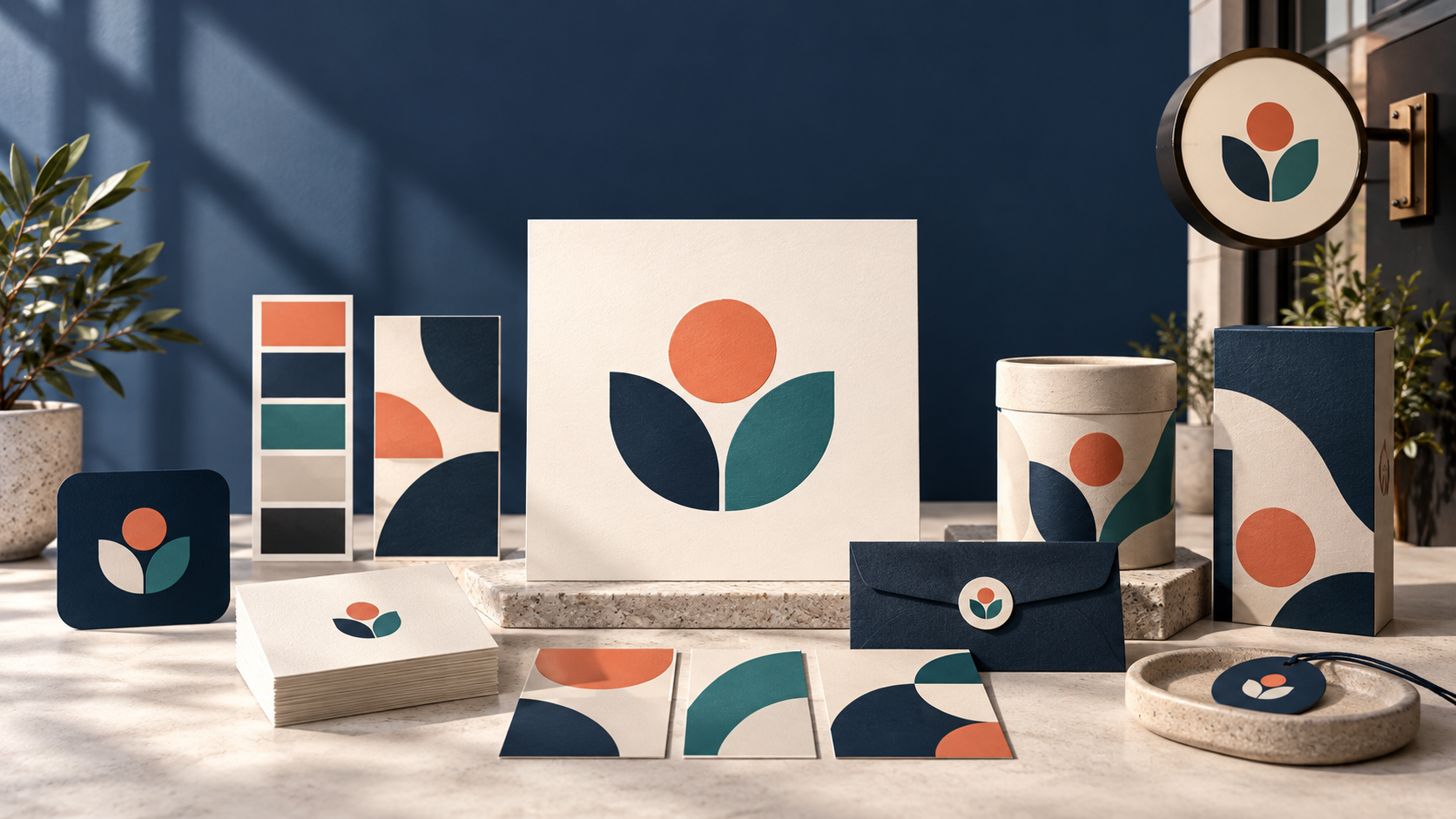
Brand identity turns a logo into a repeatable visual language. It may include a color palette, type choices, imagery direction, patterns or illustration elements, icon style, layouts, and guidelines for using them. It also includes the working versions that make everyday use easier: a social profile image, website header, business card, presentation template, packaging label, vehicle graphic, or sign—depending on what your business needs.
The point is not to make every item look identical. The point is to make them feel connected. A customer who moves from your Instagram post to your website to a printed estimate should see consistent signals: a familiar logo treatment, a repeatable use of color and type, and an overall tone that suits the business.
At 48hourslogo, a brand identity design can extend a logo to items such as business stationery, social media assets, apparel, signage, and vehicle graphics. The overview of what is included in a brand identity design project can help you identify the assets relevant to your launch rather than ordering a generic list.
Logo vs. brand identity: the practical difference
A logo answers: “Whose is this?” It is the repeatable identifier customers see on a tab, product, sign, or receipt.
A brand identity answers: “What should this business feel like wherever I meet it?” It organizes the choices around the logo so that a website, document, social post, and package do not look as if they came from four unrelated businesses.
Your brand is broader still: it includes what customers experience and remember—the offer, service, product quality, voice, reputation, and every interaction. Design can make the intended impression clearer, but it cannot substitute for delivering the promise. Keeping these three ideas separate makes planning easier: a logo is a visual asset, an identity is a visual system, and a brand is the overall impression built through experience.
When a logo is enough for now
A focused logo project is a sensible first step when you have a narrow launch scope. Perhaps you need to validate a new service, send proposals, open a basic website, create a profile, or put a name on a van. In that case, ask for a logo that does real work: a full-color version, a one-color version, a light-on-dark version, and a compact option where appropriate. Make sure it is readable at small sizes and usable in the file formats you will need.
You can then choose a small, consistent set of supporting choices yourself: one or two colors, a readable web font, and a simple photo treatment. Document them in a one-page note. This gives you enough consistency to communicate clearly while you learn what materials and channels customers actually use.
Do not mistake “start lean” for “use the logo differently every time.” Even a small business should decide which logo version belongs on which background, where it sits in a document, and how much empty space it needs. Consistency is often more valuable than adding visual effects.
When you need a fuller identity from day one
A more complete identity is worth planning early when a customer will encounter your business through several visible formats in a short period. Retail, hospitality, events, physical products, franchises, and businesses with a busy sales team are common examples. If opening week requires menus, packaging, window graphics, uniforms, social posts, a website, and printed collateral, designing those components independently can create an inconsistent result and extra rework.
It also makes sense when the category depends heavily on presentation. A premium gift brand, interior studio, wellness practice, restaurant, or real-estate team may need carefully defined typography, imagery, and layout to communicate the intended level of service. That does not require a huge rulebook. It requires a short, useful system that tells the next person creating an asset how to make it look like it belongs.
Build the identity in the order customers will see it
You do not have to create every possible asset at once. Start with the logo, then list your first customer touchpoints in order. For a local service business, that might be a vehicle, work shirt, quote, website, and local listing profile. For an online shop, it might be product packaging, product images, email, web pages, and social content. For a consultant, it could be a website, proposal, slide deck, and invoice.
Choose the first three to five applications, then make sure the identity works in each. That approach prevents a beautiful brand guide from sitting unused while the things customers actually see are assembled in a hurry. It also gives your designer a more useful brief. Explain the audience, the intended feeling, the first applications, and what is non-negotiable. The logo design brief template is a practical starting point for that conversation.
Keep legal and ownership questions separate from design preference
A design can look appealing and still raise questions about availability or similarity. Do not use visual preference alone to resolve those questions. WIPO’s guide for small and medium-sized enterprises explains that trademarks can include logos and recommends searching to see whether a selected name is used as a trademark by a competitor for similar goods or services. Review WIPO’s introduction to trademarks and brands, and seek qualified advice for your markets and circumstances.
Likewise, clarify what files, permissions, and handoff materials you will need before finalizing a project. That is a business decision with practical consequences, not an aesthetic detail. Keeping it on the checklist protects the work you are investing in.
A simple decision guide
Start with a logo if: you need one clear identifier, have only a few launch channels, are still testing the offer, or need to move quickly with a limited set of materials.
Start with a logo plus a small identity kit if: you need a website, basic social presence, proposals or stationery, and a reliable way to keep those pieces visually connected.
Plan a fuller brand identity if: the launch includes multiple customer-facing formats, physical environments, packaging, a team creating content, or a position that depends on a carefully managed experience.
The right answer can change as the business grows. Begin with the clearest priority, make it usable, and expand deliberately. A logo gives people a sign to remember. A brand identity makes that sign part of a coherent world. Both are valuable—what matters is choosing the scope that helps your next customer recognize, understand, and trust your business.