
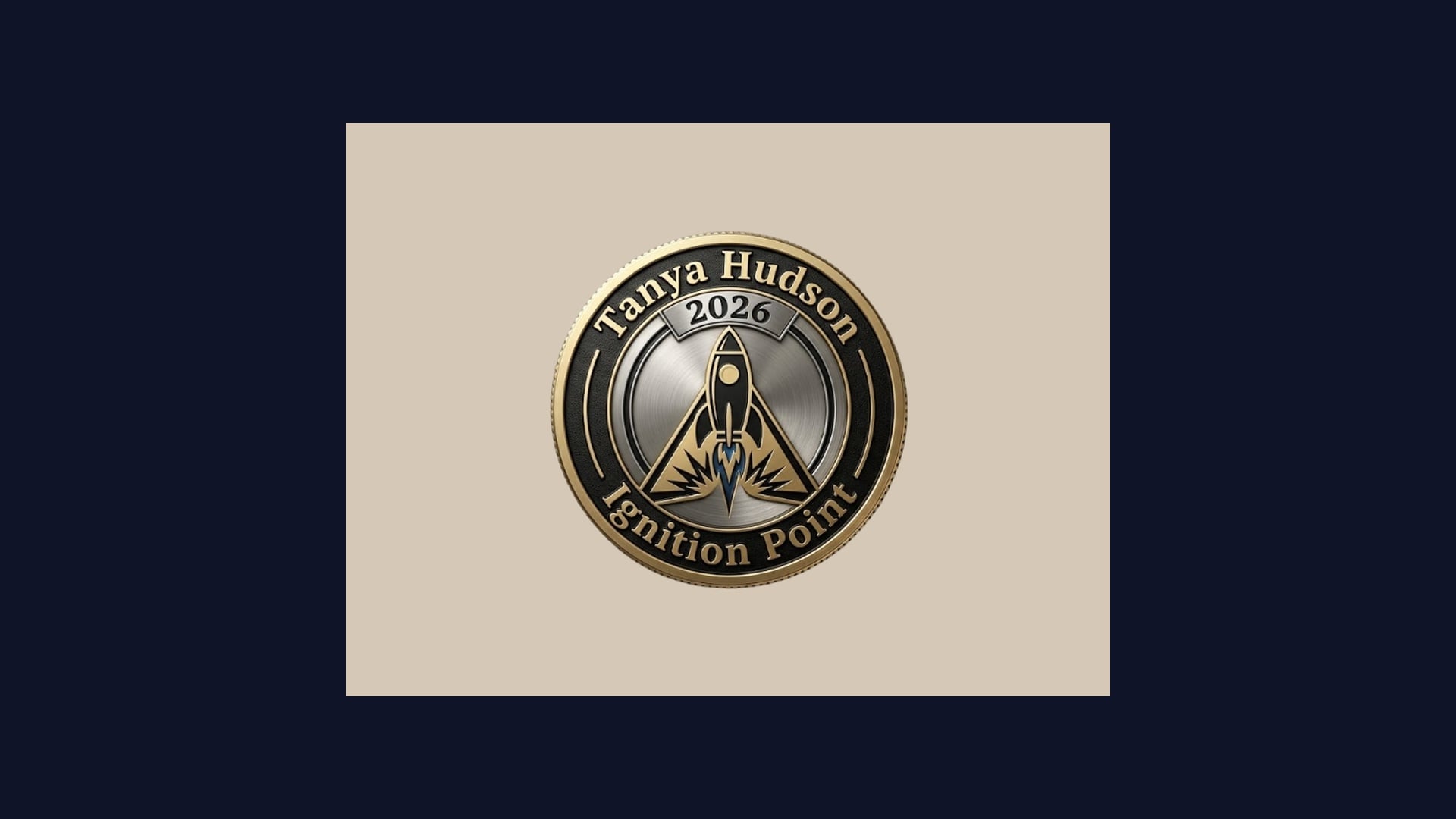
When designing a challenge coin or an emblem logo for a professional business organization, the stakes are high. The design needs to be authoritative, memorable, and capable of telling a story within a very confined, circular space. It is a unique design challenge that requires a delicate balance of typography, iconography, and layout.
A recent logo design contest hosted on 48hourslogo for the "2026 Board Chair Tanya Hudson" perfectly illustrates how crowdsourcing can deliver exceptional results for highly specific, specialized design needs like challenge coins.
The Challenge: Designing for a Physical Medium
The client approached 48hourslogo with a very specific brief. They needed a design for a professional business organization's challenge coin. Challenge coins have a long history in military and professional organizations, serving as tokens of camaraderie, achievement, and leadership.
The brief included several mandatory elements that had to be seamlessly integrated into the circular design:
- The year: "2026"
- The name: "Tanya Hudson"
- The theme/slogan: "Ignition Point"
- A specific visual motif: A rocket launch
Designing for a coin is fundamentally different from designing a standard web logo. The designer must consider how the artwork will translate to a physical, metallic object. Gradients, ultra-fine lines, and overly complex details often get lost in the minting process. The design must be bold, high-contrast, and structurally sound.
The Power of Crowdsourcing: 301 Unique Perspectives
One of the greatest advantages of hosting a contest on 48hourslogo is the sheer volume of creative exploration it provides. For this project, the client received an astounding 301 submissions from 55 different designers.
Why is this volume so important for an emblem logo?
When you ask 55 different professional designers to interpret the concept of an "Ignition Point" rocket launch within a coin format, you get a massive spectrum of ideas. Some designers took a highly realistic, illustrative approach to the rocket. Others opted for sleek, minimalist, geometric interpretations. Some focused heavily on bold, commanding typography, while others prioritized the dynamic motion of the rocket's exhaust.
This diversity allowed the client to see their brief executed in dozens of different styles, making it much easier to identify exactly which visual direction resonated best with the organization's professional tone.
Analyzing the Winning Design
After reviewing over 300 concepts, the client selected a winning design by the talented designer known as "Bad Boy" (Design #220). The winning emblem is a masterclass in challenge coin design.
Here is why the winning design was so successful:
1. Perfect Spatial Hierarchy
The designer expertly utilized the circular canvas. The text "2026 BOARD CHAIR" and "TANYA HUDSON" are elegantly curved along the outer edge, framing the central artwork without crowding it. This creates a classic, authoritative seal aesthetic.
2. Dynamic Central Imagery
The rocket launch is the focal point, and it is executed brilliantly. The rocket breaks the inner circle, creating a sense of upward momentum and breaking boundaries—perfectly capturing the "Ignition Point" theme. The use of stars in the background adds depth and context to the space theme.
3. High-Contrast Execution
The designer presented the concept using a metallic gold and deep navy blue color palette. This high-contrast approach not only looks incredibly premium and professional on screen, but it also clearly demonstrates to the client exactly how the design will look when physically minted as a two-tone metal and enamel coin.
4. Clear, Legible Typography
Despite the complex imagery, the typography remains the hero. The designer chose clean, modern sans-serif fonts for the primary text, ensuring that the name and title will be easily readable even when the coin is held in the palm of a hand.
What the Client Achieved
By choosing to run a contest rather than hiring a single designer, the client achieved several critical outcomes:
Risk Mitigation: They didn't have to hope that one designer would "get it." They were able to view hundreds of fully realized concepts before making a final decision.
Rapid Iteration: The contest format allowed the client to provide feedback in real-time, guiding the designers toward the perfect balance of elements.
A Production-Ready Asset: The winning designer understood the medium. The final file wasn't just a pretty picture; it was a structurally sound emblem ready to be sent to a coin manufacturer.
Conclusion
Emblem logos and challenge coins require a specific set of design skills. They must be timeless, authoritative, and physically reproducible. The Tanya Hudson "Ignition Point" contest proves that when you combine a clear brief with the creative power of a global design community, the results are spectacular.
If your organization needs a professional emblem, seal, or challenge coin, crowdsourcing is one of the most effective ways to explore your options and guarantee a high-quality result.